MedIntMMI
Customer Journey Design
Designing the end-to-end customer experience for an AI-powered medical MMI interview preparation platform, from onboarding through to performance benchmarking.
Role
Product Designer
Timeline
Dec 2025 – Present
Location
Hong Kong
Tools
Figma · Google Stitch · Miro
The Challenge
Medical MMI (Multiple Mini Interview) preparation is notoriously complex, candidates must develop a broad range of competencies across ethical reasoning, clinical scenarios, communication, and time pressure.
MedIntMMI needed an app experience that could guide different types of users through personalised learning journeys, without feeling overwhelming or clinical.
The Approach
I designed four distinct customer journeys, each mapped to a different user persona and learning mode, using Google Stitch and Figma.
Each journey was designed from scratch: user research, flow mapping in Miro, wireframing, then high-fidelity UI screens with a cohesive dark-mode design system built around depth, clarity, and momentum.
The Four Customer Journeys
Each journey maps a distinct user mode, from habit-building daily practice through to full exam simulation.
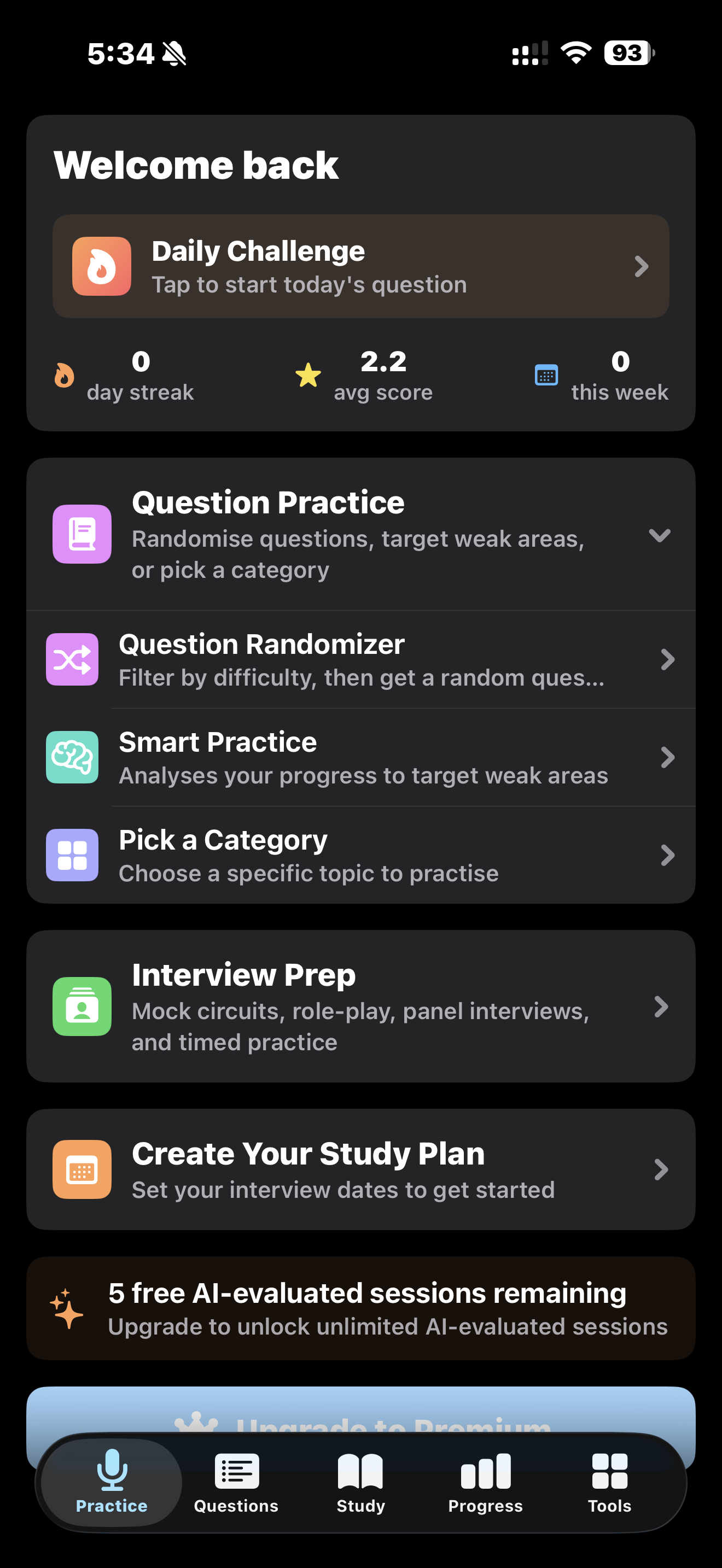
Home Hub & Daily Challenge
The Practice hub puts every mode within a single tap: Daily Challenge for a one-question prompt that builds streak momentum, Smart Practice for AI-targeted weakness work, Interview Prep for full circuit simulation, and Create Your Study Plan to anchor preparation to real interview dates. A persistent free-tier indicator — "5 free AI-evaluated sessions remaining" — creates urgency at the moment the candidate has already navigated to the practice screen.
Daily Challenge at the top, a single-question prompt is the lowest-friction entry point, designed to build a daily habit from the very first session
Five practice modes, Question Practice, Question Randomizer, Smart Practice, Pick a Category, and Interview Prep, all accessible from the home screen with no buried navigation
Free tier visible, remaining AI-evaluated sessions shown on the home screen, surfacing the upgrade prompt before a session is even started
AI Feedback & Session Review
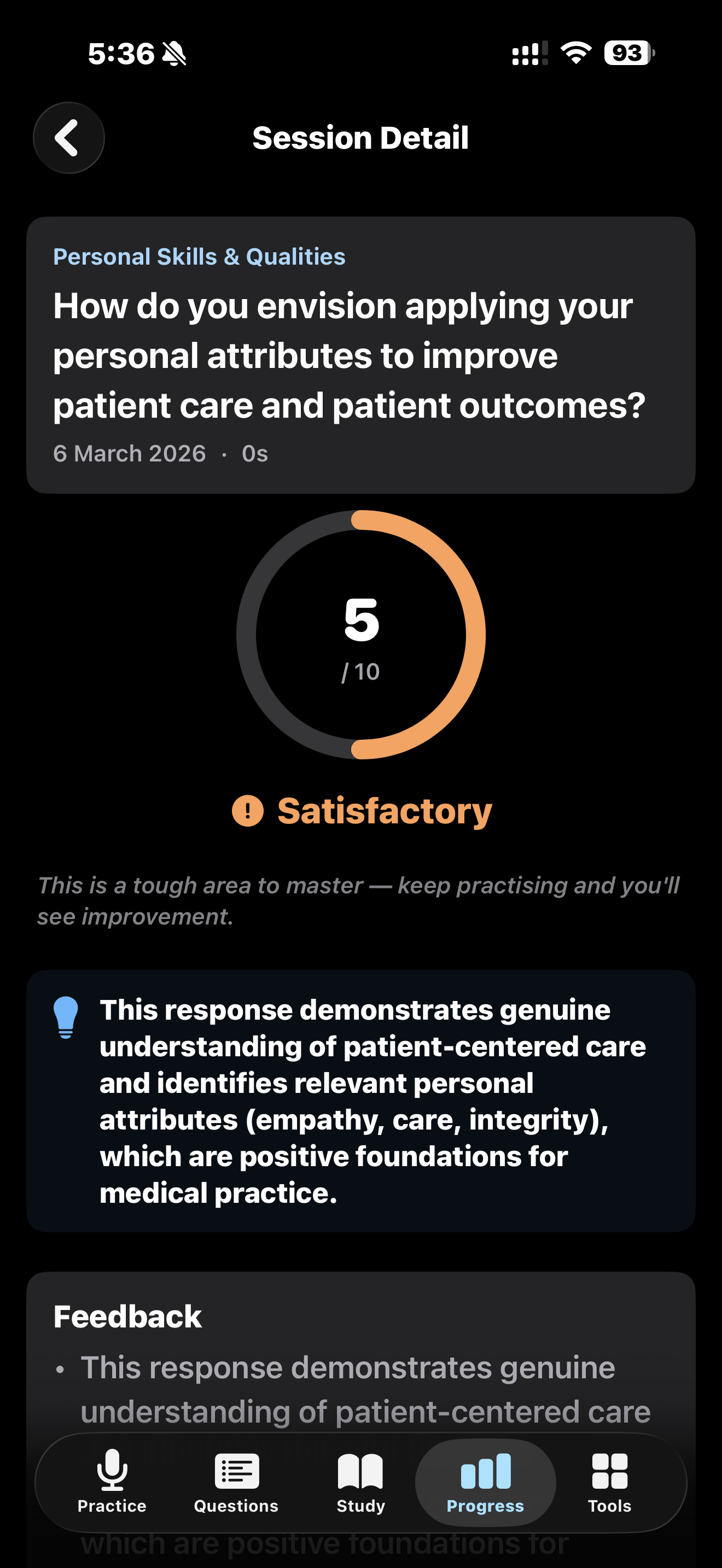
After completing a question, the Session Detail screen delivers a score (5/10 here, rated Satisfactory) alongside a candid coaching note and an AI-generated highlight that names exactly what the response got right — genuine understanding of patient-centred care, grounded in empathy, care, and integrity. Detailed written feedback follows, structured to show what worked and what to improve next time.
Score + plain-English rating, a numeric score paired with a label ("Satisfactory") gives instant context before reading any detail
Motivational coaching note, a short line acknowledges that Personal Skills is a tough area to master, reducing abandonment after a low score
AI highlight, the model surfaces specific phrases from the actual answer — empathy, care, integrity — so the user knows exactly which parts to replicate next time
Mock MMI Circuit
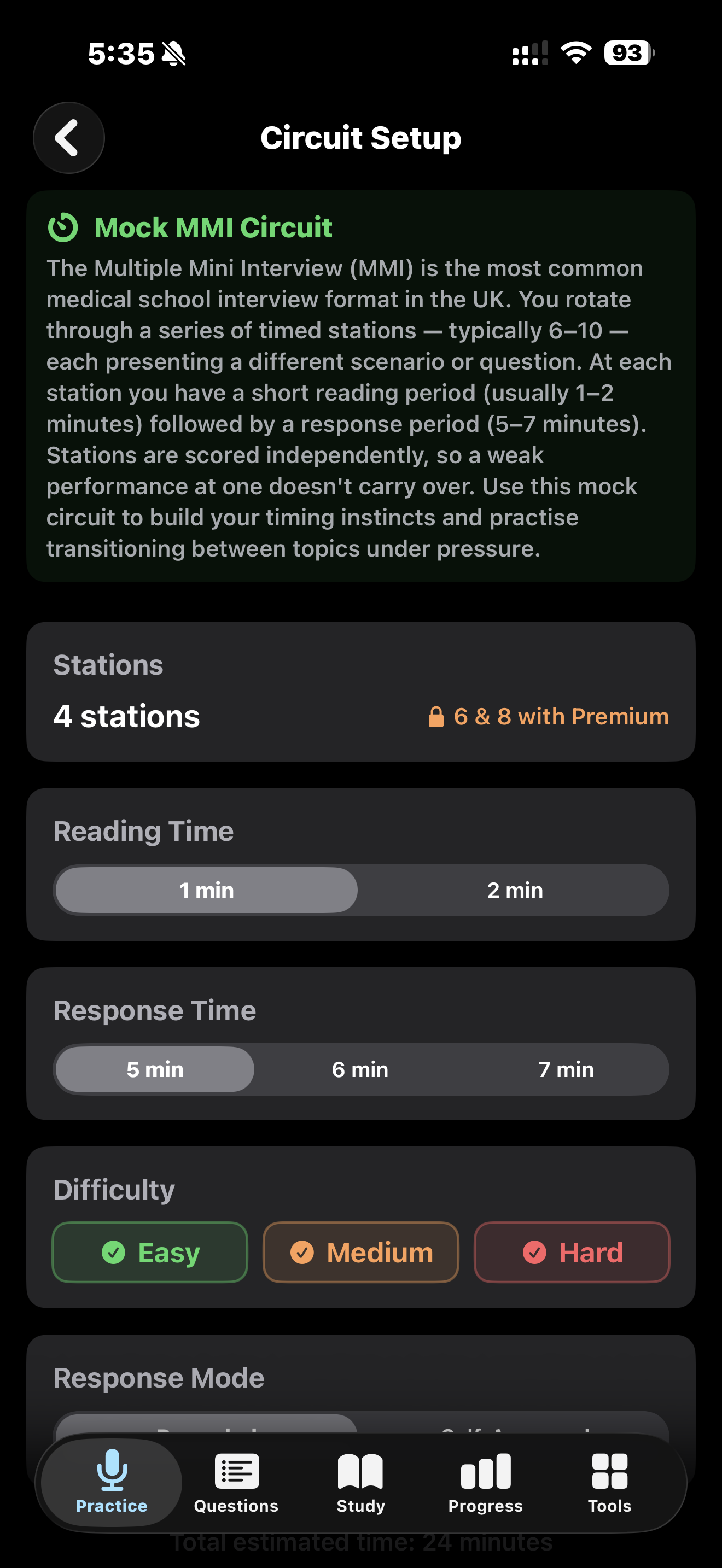
Circuit Setup configures a realistic MMI simulation: station count (4 free, 6 and 8 with Premium), reading time per station (1–2 min), response time (5–7 min), and difficulty. The screen opens with a plain-language description of how the real MMI works — rotating through independent timed stations — so even a first-timer understands the format before they begin.
Format explained in-context, a paragraph describing how the real MMI works sits above the setup controls, so users learn the format while configuring it
Granular timing control, separate reading time (1–2 min) and response time (5–7 min) selectors mirror the real variation across different UK medical schools
Station count as conversion point, 4 stations are free while 6 and 8 are Premium-locked, demonstrating the upgrade value through the product itself
University Guide & School Intelligence
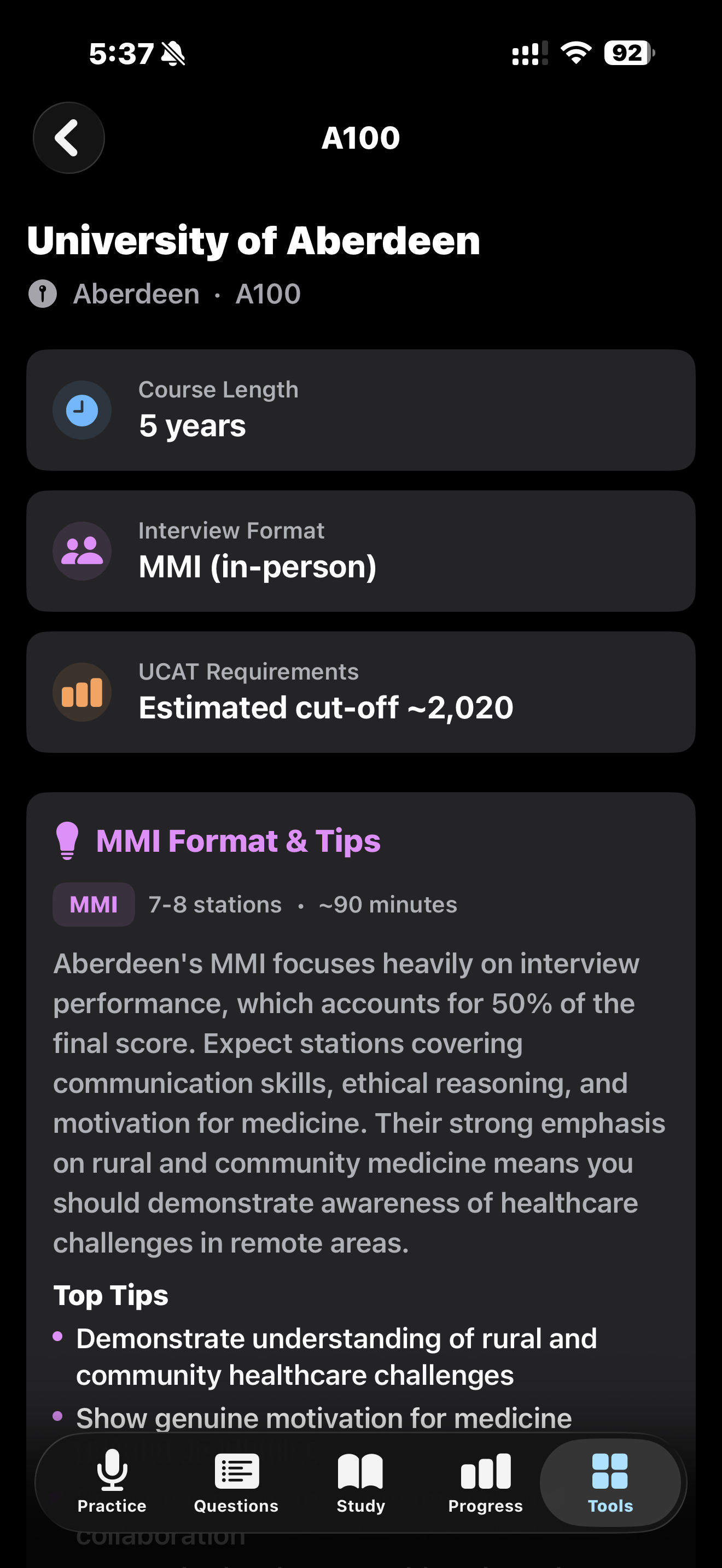
The University Guide surfaces school-specific intelligence that goes beyond generic MMI tips. Aberdeen's entry shows course length (5 years), interview format (MMI in-person), estimated UCAT cut-off (~2,020), and a Tips section written for that specific school — its 50% interview weighting, emphasis on rural and community healthcare, and the qualities Aberdeen's assessors look for. This is the research candidates currently piece together from three different websites.
School-specific facts, course length, interview format, and UCAT cut-off in one screen instead of three different websites
MMI format per school, station count (7–8 for Aberdeen) and session length (~90 min) so candidates can calibrate their circuit practice to each school
Contextual top tips, guidance written for Aberdeen's specific values — rural medicine, community health — not generic MMI advice that applies to every school
Design Outcomes
Each mapped to a specific persona and learning mode, from habit-building to exam simulation.
The Obsidian Navigator system, built for depth, editorial clarity, and dark-mode legibility.
From user research and Miro flows through to high-fidelity Figma screens and Stitch prototypes.
Interested in this project?
Let's talk about how I can bring this kind of thinking to your product.